
Why does my child keep forgetting multiplication facts?
By Steven Snyers, maker of Pet Rocket ·
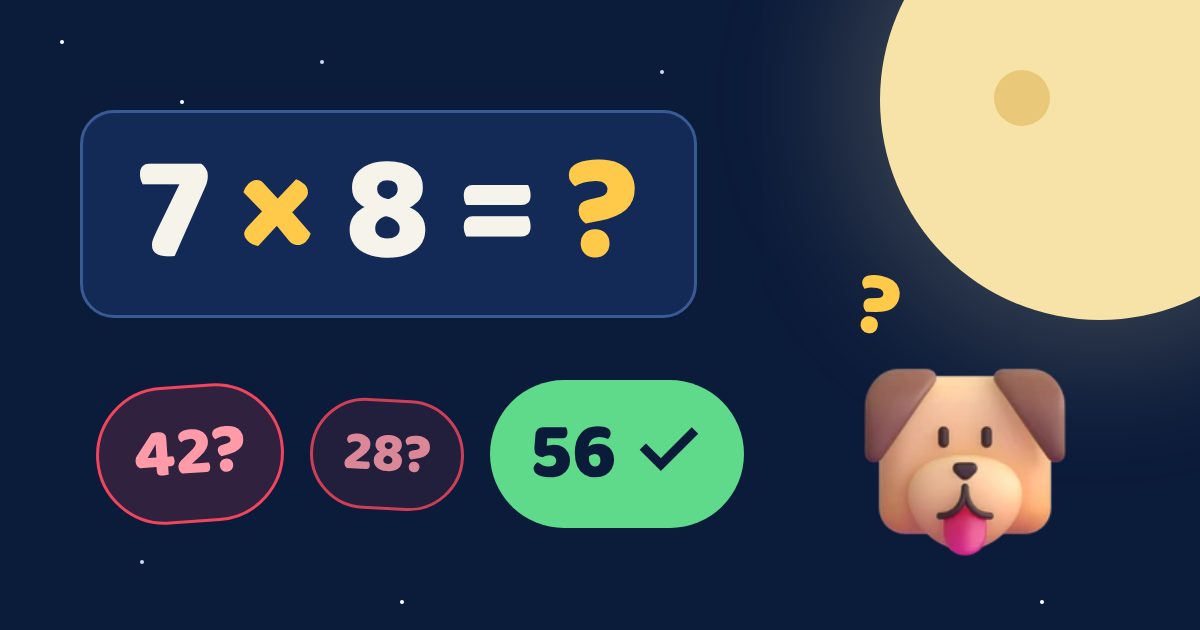
Your child knows the 7s. A week later, they’re gone.
Sound familiar? You practice together. It goes well. And a few days later, your child can’t remember them.
You ask: "What’s 7 × 8?" Your child says: "42?"
That’s normal. It isn’t laziness. And you’re not doing anything wrong. Here’s why it happens, and what really helps.
Want to try something tonight? Ask five facts out of order, not the whole list. Wait while your child finds the answer. Wrong? Calmly give the right answer. Ask the same fact again tomorrow.
Why does my child forget multiplication facts so quickly?
Forgetting is completely normal. We’ve known that for more than 140 years. Back then, a German scientist tested it on himself. He memorized lists of nonsense syllables and checked how fast he forgot them. After one day, most of it was gone. After that, forgetting slowed down.
In 2015, scientists at the University of Amsterdam repeated the test. They found almost exactly the same pattern.
For multiplication facts, that means what your child knows today hasn’t stuck yet. Without practice, it fades. And it fades fastest in the first few days.
Figuring it out or just knowing it: what’s the difference?
Some kids figure out 7 × 8. They think: 5 × 8 is 40. Add 2 × 8, that’s 16. Together, 56.
That’s smart. Your child understands how multiplication works. But it takes a long time, and it’s hard work for the brain. If your child knows "56" right away, their head is free for something else, like a harder problem or a word problem.
Scientists at Stanford University used brain scans to see how kids ages 7 to 9 solve simple problems. At first, they count and figure things out. After a while, they simply recall the answer. That step takes a long time. It doesn’t happen in one evening.
That’s why your child seems to know the 7s on Sunday. The order still helps then: 1 × 7, 2 × 7, 3 × 7... On Friday, that order isn’t there. And then it turns out the answer hasn’t stuck yet.
Most US schools expect kids to know their single-digit multiplication facts from memory by the end of 3rd grade.
Why are the 6s, 7s, and 8s so hard?
Many kids find the 6s, 7s, and 8s the hardest. Some find the 9s hard too. Even adults take longer on 7 × 8 than on 2 × 3.
Part of the explanation comes from Belgium. Researchers at UCLouvain found that multiplication facts get mixed up in our heads. Look:
- 6 × 8 = 48
- 7 × 8 = 56
- 6 × 9 = 54
Similar digits. Answers that look alike. Your child is looking for 56, but 54 jumps in first. Some kids are more prone to this, and they find multiplication especially hard.
Researchers at Tel Aviv University in Israel showed how strong this can be. A woman who really struggled with multiplication learned four facts a week. If the four looked alike, it didn’t work. If they were very different, she learned them quickly. Two months later, she still knew them.
Does your child say "42" for 7 × 8? Then it’s often not a careless mistake. 42 is 6 × 7. A neighboring fact simply got in the way.
And division? For 56 ÷ 7, your child has to think: which 7s fact makes 56? If your child doesn’t know 7 × 8 well yet, dividing turns into guessing. A division fact is only as solid as the multiplication fact behind it.
Want to practice one set of facts? The 7 times table page has every fact and a handy trick. For dividing, see division facts practice.
What we see in Pet Rocket
From October 28 through November 5, 2026, 53 players played 143 rounds in Pet Rocket. They answered 1,565 problems. These were the multiplication facts they missed most often (7 × 8 and 8 × 7 count together):
| Problem | Missed |
|---|---|
| 8 × 8 | 5 out of 12 times |
| 6 × 7 | 9 out of 25 times |
| 6 × 8 | 8 out of 22 times |
| 7 × 8 | 11 out of 32 times |
For comparison: 7 × 10 was right all 15 times, without a single mistake.
Look at the wrong answers too. For 7 × 8, kids most often typed 28 or 42. Those are 4 × 7 and 6 × 7, facts from the same set. For 6 × 7, the most common wrong answer was 36: that’s 6 × 6. It looks just like what the researchers at UCLouvain describe: a neighboring fact jumps in first.
These are only the first numbers, from a small group of players. But they match what many parents see at home.
Good news: there are fewer than you think
The facts from 1 to 10 look like 100 problems. But most kids learn the 1s, 2s, 5s, and 10s quickly. And 3 × 7 is the same as 7 × 3. Knowing that cuts the work in half. Then only 21 facts are left. And only a few of those are really tricky.
Does reciting the times tables help?
"Seven times one is seven, seven times two is fourteen..." That’s how most parents learned. After ten times, it flows. It feels like you’ve learned it.
Reciting helps your child get to know a set of facts. But what your child mainly remembers is the order. Ask 8 × 7 without starting from the beginning, and the answer often doesn’t come.
Researchers at the Open University of the Netherlands tested this in four classes of 7- and 8-year-olds, about the age of second graders. For the 3s, half of the classes recited out loud. The other half practiced with flashcards: the problem on the front, the answer on the back. Think first, then flip it over. For the 4s, they switched. So every child did both, in three five-minute sessions each.
With the flashcards, the kids knew noticeably more facts afterward. A week later, too.
The surprising thing is that reciting feels better. Finding the answer yourself feels harder. Yet it sticks better. Adults fall for this too. We pick what feels easy, not what works best.
How can I help my child memorize multiplication facts?
Scientists recently looked at 53 studies in real classrooms, with more than 7,000 students. Their conclusion: these ways of practicing help, in regular classrooms too.
1. Let your child find the answer
Ask 7 × 8 and wait. Don’t say the answer. Don’t let them recite the whole list. Searching is exactly what makes memory stronger, even if it takes a moment. Your child doesn’t know? Then give the right answer right away.
2. A little, often
A few minutes on lots of different days works better than everything at once. It’s one of the best-known findings in research on learning. Each time your child has to recall a fact again, it sticks a little better.
3. One set first, then mix them up
Learn a new set of facts in order first. Explain how it works too: 7 × 8 is 7 × 10 minus 7 × 2. Once your child half-knows the set, mix the problems up. For example 7 × 8, then 6 × 9, then 8 × 4. That shows whether your child really knows the fact, not just its place in the list.
You’ll find a handy trick for each set in multiplication facts practice.
4. Practice what’s hard
Doing 2 × 5 twenty times feels nice. But your child learns nothing new from it. Focus on the five or six facts your child keeps missing. Bring a missed one back a few problems later, while the right answer is still fresh.
What doesn’t work?
Practicing for too long. The longer you keep going, the harder it is for your child to focus. And the sooner it ends in tears. Stop while it’s still going well.
Stress. Kids can get anxious about math very young. Researchers at the University of Chicago saw it in kids ages 6 to 8. What stood out: anxiety went along with lower scores, especially in kids with a strong memory. The worry probably takes up room in their head. So a calm mood really matters.
Timed tests too soon. Answering quickly matters. But first the answer has to be right. Speed comes after that.
Multiplication practice at home: a few minutes a day
- Pick a set time. For example after school. Two minutes five times a week is better than twenty minutes once.
- Start easy. A few facts your child already knows.
- Then the hard ones. The ones your child missed last time. Wait while your child finds the answer.
- Missed one? Try it again later. Give the right answer. Ask the same fact a little later.
- Multiply, then divide. After 7 × 8 = 56, also ask 56 ÷ 7.
- Write down what your child misses. A list on the fridge is enough. Then you know where to start tomorrow.
Let’s be honest: it’s a lot of work. You have to keep it up every day and remember which facts are hard. And you have to stay patient. That’s where many families give up after a week.
Where Pet Rocket helps
I made Pet Rocket for my youngest son. Multiplication was hard for him. It’s a free game. Your child practices multiplication and division with it on their own. I’ve put as many of the tips above into it as I could.
Why I made the game: read our story.
Your child picks a pet buddy and flies to the Moon in a rocket. Each right answer brings the rocket closer. A game is two one-minute rounds, short enough for every day. Your child types every answer, so there’s no list to lean on. Your child can practice multiplication, division, or a mix. Want to practice the hardest ones? Then your child picks "The hardest (6–8)". For every set of facts your child knows, they earn a planet.
No account needed. No ads. Your child’s name stays on your own device.
Multiplication facts still not sticking? That’s what the Multiplication Coach is for, part of the Moon Pass. The Multiplication Coach remembers which facts your child misses. Those facts come up more often. A missed fact comes back after just a few problems. Facts your child already knows come up now and then, so they don’t fade. As a parent, you see which facts are still tricky. The Moon Pass isn’t on sale yet. Join the waiting list to hear when it launches.
How the Multiplication Coach works
Help multiplication facts stick
Frequently asked questions
Is it normal that my child keeps forgetting multiplication facts?
Yes. Forgetting is part of learning. A fact only sticks when your child has to recall it on different days.
How long should my child practice each day?
A few minutes is enough, as long as it happens almost every day.
Why are the 6s, 7s, and 8s so hard?
The numbers are bigger, and the answers look alike: 48, 54, 56. That’s why kids mix them up.
My child still figures out the facts. Is that a problem?
No. That’s a normal step. It shows your child understands how multiplication works. Later, the answer should come right away.
Why is division even harder?
To divide, your child has to use the multiplication fact backward. If they don’t know it well, dividing doesn’t work either. So practice them together.
How can I help my child memorize multiplication facts?
A few minutes almost every day, out of order, with the hard facts more often. Let your child find the answer before you say it.
Does reciting help?
To get to know a set of facts, yes. To remember them, finding the answer yourself works better.
When should I worry?
Finding multiplication hard is very normal. Many kids need months. Still not working after a lot of practice? Or is other math very hard too? Then talk to your child’s teacher, and ask whether the school can check for extra math support.
Sources
- Cepeda e.a. (2006). Distributed practice in verbal recall tasks. Psychological Bulletin, 132(3), 354–380. pubmed.ncbi.nlm.nih.gov
- De Visscher & Noël (2014). Arithmetic facts storage deficit: the hypersensitivity-to-interference in memory hypothesis. Developmental Science, 17(3). doi.org
- Dotan & Friedmann (2019). Reducing interference improves the memorization of multiplication facts in case of hypersensitivity to interference. Journal of Numerical Cognition, 5(3). jnc.psychopen.eu
- Kornell & Bjork (2008). Learning concepts and categories: Is spacing the "enemy of induction"? Psychological Science, 19(6), 585–592.
- Murray, Horner & Göbel (2025). A meta-analytic review of the effectiveness of spacing and retrieval practice for mathematics learning. Educational Psychology Review, 37, 75. doi.org
- Murre & Dros (2015). Replication and analysis of Ebbinghaus’ forgetting curve. PLOS ONE, 10(7), e0120644. doi.org
- Noël & De Visscher (2014). The detrimental effect of interference in multiplication facts storing. Journal of Experimental Psychology: General. doi.org
- Ophuis-Cox, Catrysse & Camp (2023). The effect of retrieval practice on fluently retrieving multiplication facts in an authentic elementary school setting. Applied Cognitive Psychology, 37(6), 1463–1469. doi.org
- Qin e.a. (2014). Hippocampal-neocortical functional reorganization underlies children’s cognitive development. Nature Neuroscience, 17(9), 1263–1269. pmc.ncbi.nlm.nih.gov
- Ramirez e.a. (2013). Math anxiety, working memory, and math achievement in early elementary school. Journal of Cognition and Development, 14(2), 187–202. news.uchicago.edu
- Ruitenburg e.a. (2026). A meta-analysis of the effectiveness and boundary conditions of retrieval practice, distributed practice, and interleaved practice in authentic school classrooms. Educational Psychology Review, 38. doi.org
Know other parents dealing with this? Send them this article.