
Times tables instant recall: what it means and how to help at home
By Steven Snyers, maker of Pet Rocket ·
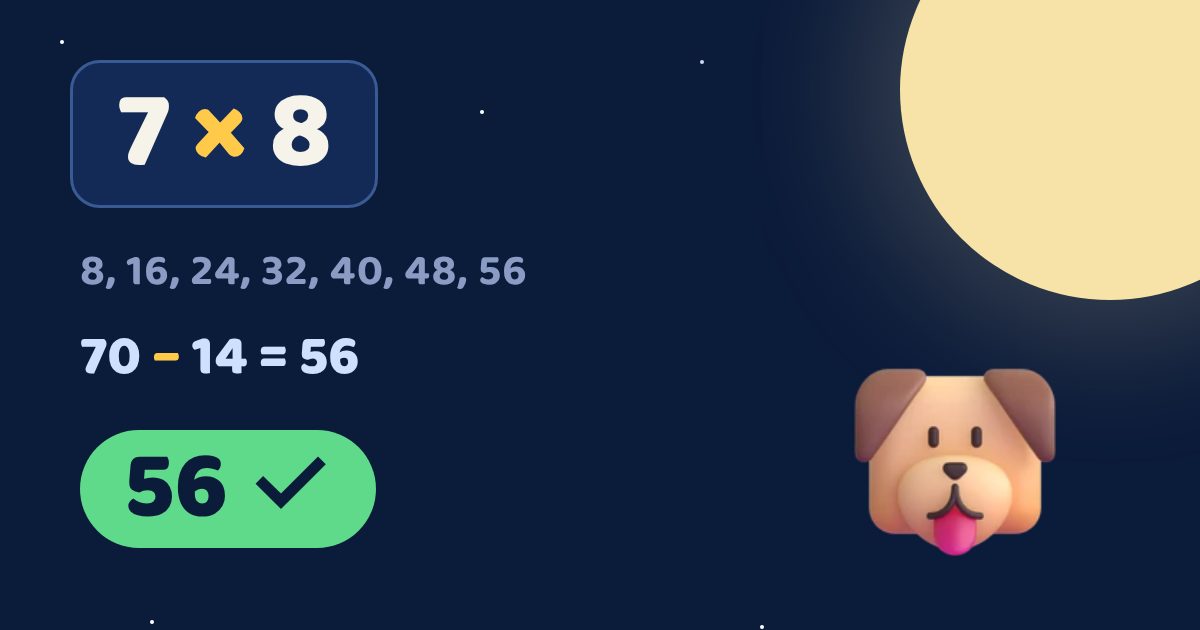
The teacher says it at parents’ evening, or it is on the school report: "Times tables need to become more automatic."
But your child knows them, surely? At home, 7 × 8 nearly always comes out as 56. It just takes a while. Your child is still working it out, quietly or on their fingers.
That is often what the school means: the answer is right, but it does not come quickly enough yet. The aim is for your child to get quicker at working out the answer, until they know it without having to work it out.
Working it out or just knowing: what is the difference?
Teachers talk about two things that often go together.
- Fluency: your child works a fact out quickly and correctly. It’s fine to use a quick mental step.
- Instant recall: your child knows the answer straight away, without working it out. Like you know your own address.
Three ways to get to 7 × 8
| How | What you hear | How long |
|---|---|---|
| Counting | "8, 16, 24, 32, 40, 48, 56" | long |
| Working it out | "7 × 10 is 70, take away 2 × 7, so 56" | shorter |
| Just knowing | "56" | straight away |
Counting and working it out are not mistakes. They show that your child can find a way to the answer. But a child who has to work out every fact has less room in their head for the rest of the problem.
See the table as a guide, not a fixed ladder. Children use all three ways side by side, and differently for each fact. Researchers at Carnegie Mellon University followed twenty French children of about 7 for a whole school year while they learned their tables. With easy facts they more often took the answer from memory, with hard ones they more often added up. By the end of the year they knew many more facts straight away, hard ones too.
When should the times tables be automatic?
In England, the national curriculum sets out:
- Year 2: the 2, 5 and 10 times tables.
- Year 3: the 3, 4 and 8 times tables.
- Year 4: all times tables up to 12 × 12. In June, children in Year 4 take the Multiplication Tables Check. It has 25 questions, with 6 seconds for each answer.
Read more at times tables by year group and the Multiplication Tables Check.
Schools ask for this because harder maths builds on it. A sum like 48 × 3 or a long division is full of small times table facts. If your child has to work each of them out, they lose track halfway.
What does research say works?
Researchers at the University of Notre Dame and Western University brought together what is known about fluent arithmetic in 2025. For home, their advice comes down to four things:
- Understanding what a fact means.
- Clever in-between steps, such as using 10 as a stepping stone.
- Recalling the answer yourself, often and briefly.
- Only then speed, once the facts are mostly right.
It is not a strict step-by-step plan. Understanding and practice keep strengthening each other. But speed always comes last.
A first look: which facts come straight away?
This is not a test and not a diagnosis. It is a way to find out together where your child is. You don’t need a timer.
- Ask twelve separate facts in a mixed order. Include a few from the 6, 7, 8 and 9 times tables.
- After each one, ask: "How did you know?" From the outside you cannot see whether a child is working it out silently or just knows. Your child’s answer is a clue, not a measurement.
- Write a letter next to each fact: C for counting, W for working it out, K for just knowing. Not sure? Put a question mark.
- Wrong? Help through a fact your child does know. For 6 × 7: "What is 5 × 7? And then one more 7?" Then let your child say the answer.
Now you have a short list of facts that do not come straight away yet. Over the next few weeks, notice whether your child says more facts quickly and correctly, even if the letter stays the same. The teacher sees your child doing maths far more often, so feel free to compare your list with what school sees.
How to help at home, letter by letter
Lots of Cs: understanding first, then a shortcut
Does your child know what 6 × 8 means? Draw five rows of eight dots together, and one more row underneath in a different colour. Five rows make 40. With the extra row there are 48. Now your child can see why the shortcut works: 6 × 8 is 5 × 8 and one more 8.
You can find a stepping-stone fact like this for every table, such as 9 × 6 is 10 × 6 take away 6. There is one for each table at times tables tricks.
Lots of Ws: practise recalling, little and often
- A pile of their own. Write the W facts on cards. Go through them a few times a week, for just a few minutes. Let your child try first. If it doesn’t come, help with a fact they do know, or say the answer. Ask the same fact again a few minutes later.
- A second pile. When a fact comes straight away three times in a row, move it to a second pile. Go through that pile now and then, so the fact stays.
- Multiplication and division belong together. You can show the link early on: six rows of nine make 54, and 54 shared into six rows gives nine. Only put 54 ÷ 6 and 54 ÷ 9 on the pile once 6 × 9 comes easily. More about division at division facts.
How to practise so it sticks is explained in does your child keep forgetting their times tables?
Nearly all Ks, but still slow at school?
Then the problem may not be the facts themselves. Read how to practise without the battles, and talk to the teacher about it.
How Pet Rocket can help
Pet Rocket is a free times tables game for the last steps: recalling, and then speed. A round lasts one minute. The facts come one by one in a mixed order, so the order of the table does not help. After a mistake the rocket simply stays where it is, and the timer waits a moment while the right answer appears. Your child can also focus on the 6, 7 and 8 times tables, which many children find tricky.
Mostly Cs? Then start without a timer, with the dots and the shortcuts above.
No account needed and no adverts. With the Times Tables Coach in the Moon Pass, the facts your child gets wrong come up more often, and you can see which facts your child already knows well.
How the Times Tables Coach works
Help your child know their times tables by heart
Frequently asked questions
My child is in Year 3 and still works the tables out. Is that a problem?
No, that is still very common in Year 3. All tables up to 12 × 12 come in Year 4. Practise the W facts little and often, and talk to the teacher if it stays slow.
Is using a trick wrong?
No. It is a good in-between step, as long as your child understands why the trick works. Keep asking the fact until the answer comes straight away.
How do I know a times table is automatic?
Ask the facts of that table on their own and mixed up, on a few different days. If the answer comes straight away each time, and your child says they "just know it", the table is there.
Do division facts need to be automatic too?
Yes. Show the link with multiplication early, and practise the division facts once the multiplication fact comes easily.
How long does it take?
It differs for every child and every fact. In the study above, children got quicker step by step over a whole school year.
Sources
- Lemaire & Siegler (1995). Four aspects of strategic change: Contributions to children’s learning of multiplication. Journal of Experimental Psychology: General, 124(1), 83–97.
- McNeil, Jordan, Viegut & Ansari (2025). What the science of learning teaches us about arithmetic fluency. Psychological Science in the Public Interest, 26(1), 10–57. doi.org
Know other parents who struggle with this? Send them this article.